You Don’t Have to Beat Booking.com on Hotels. Win with the Whole Trip.

Large Online Travel Agencies (OTAs) compete on scale, but other travel companies do not need to match them on hotel count. They can build an advantage in a different way: by combining flights, accommodation, transfers, insurance and other services into one holiday that fits the customer's needs.
Why shouldn't travel companies compete with OTAs on hotel count?
The largest OTAs are especially strong in accommodation, so competing with them on the size of a hotel database means entering the part of the market where their advantage is strongest.
According to Phocuswright U.S. Online Travel Agency Market Essentials 2026, OTA gross bookings in the United States reached $100.3 billion in 2025. This was a 4% increase year over year and represented around 20% of the total U.S. travel market.
The sales mix tells us even more. Hotels account for 63% of OTA gross bookings, while air represents 20%. At the same time, only 13% of airlines' online passenger revenue goes through OTAs.
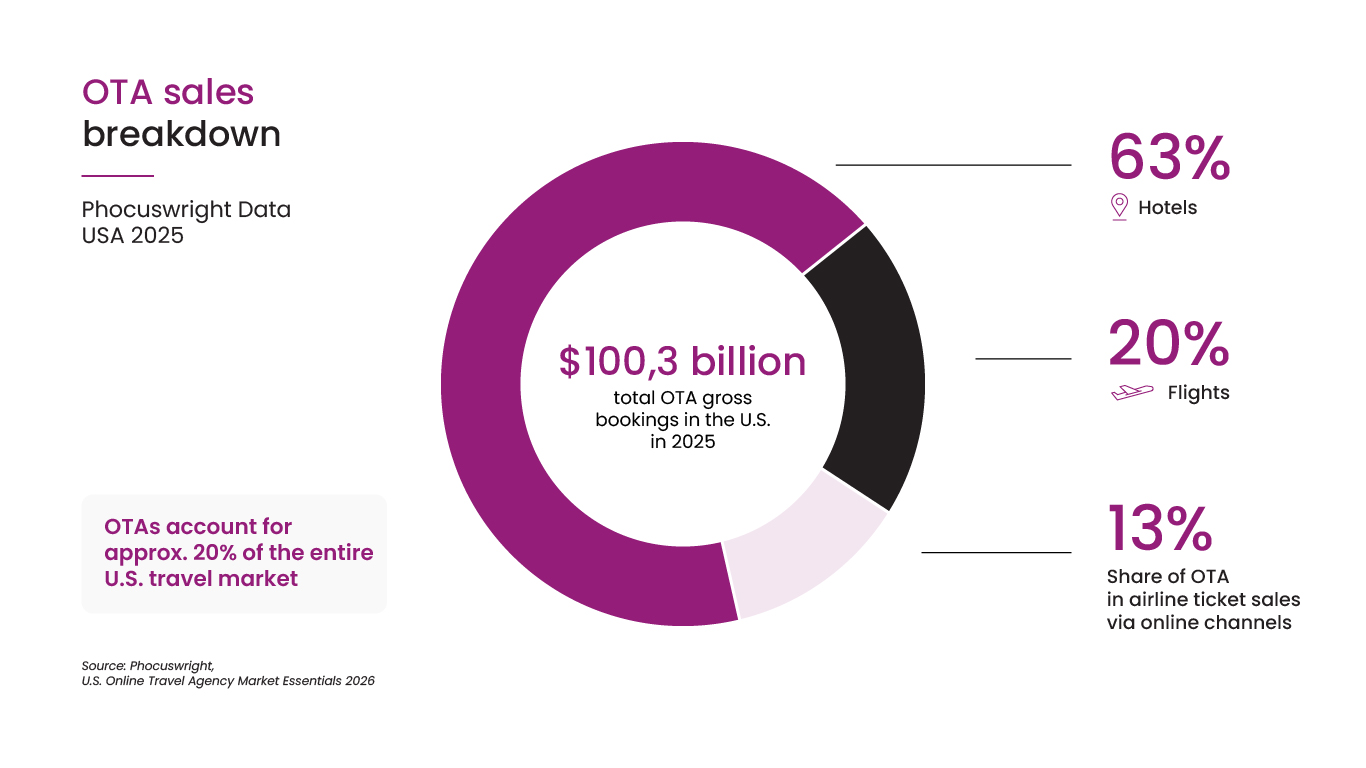
These figures show how closely the strength of major platforms is tied to accommodation. For a smaller travel agency or tour operator, the more useful question is not "How can we offer more hotels?" but "Should we compete with the largest players in the area where they are already strongest?"
What is the difference between selling a hotel and selling a whole holiday?
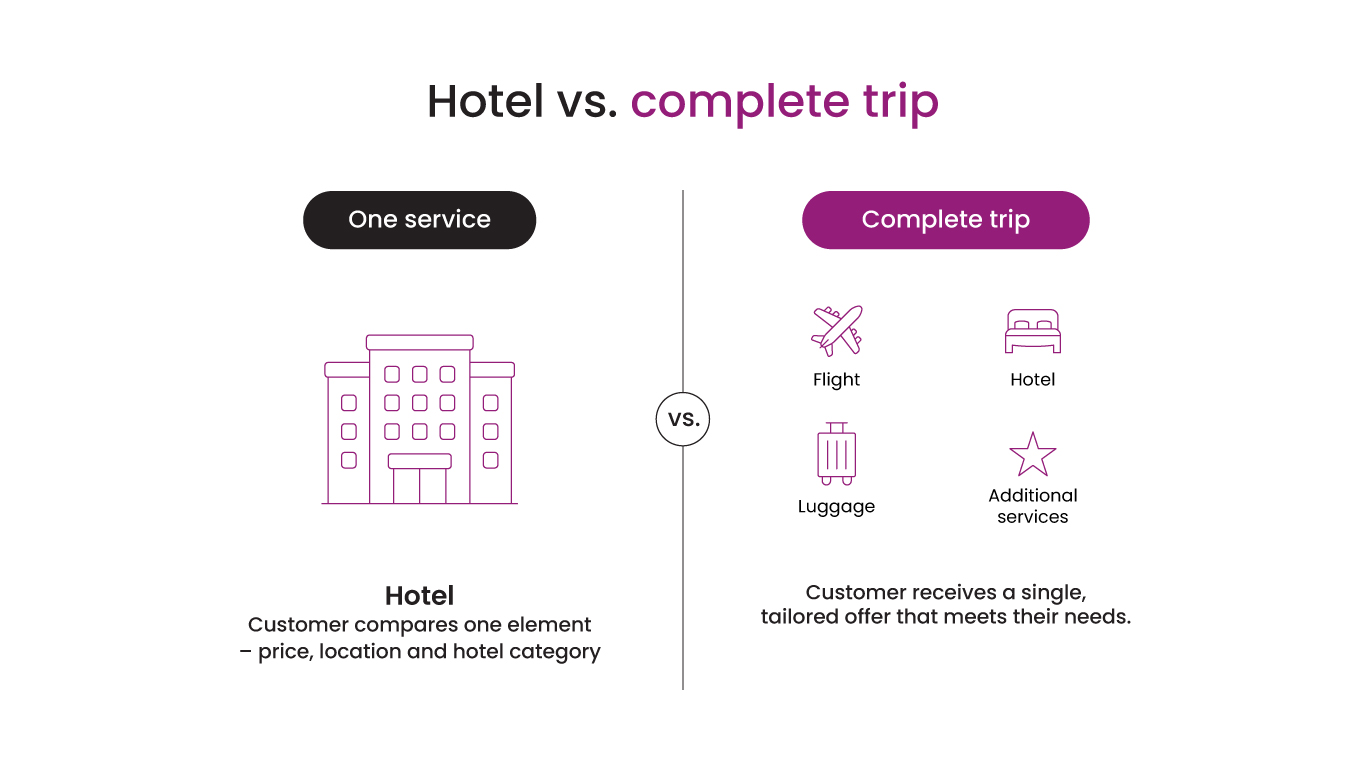
A hotel is only one part of a trip. The customer needs the whole holiday to work in terms of timing, price and logistics.
Someone planning a week in Tenerife may start by searching for accommodation. They still need to find a suitable flight, choose baggage, arrange transport from the airport and buy insurance. Car rental or activities may also be part of the plan.
A complete holiday may include:
- a flight at the right time,
- a hotel at the expected standard,
- baggage,
- airport transfer,
- insurance,
- extra services.
Each of these can be booked separately. The customer then has to check whether all parts of the trip work together.
A travel agency can take over that process and offer a ready-made option. Competition is no longer based only on the number of hotels available. What matters is who can combine the right services into a trip that fits a specific customer more efficiently.
Why doesn't a broad product range automatically create a "connected trip"?
Having flights, hotels, transfers and activities in one service is not enough to create one connected trip. Booking Holdings is a good example.
In 2019, Booking Holdings CEO Glenn Fogel introduced the "connected trip" strategy. The aim was to create an environment where customers could arrange different parts of their travel in one place.
Mario Gavira in Booking Holdings' 'connected trip' vision never materialized, and AI is the latest threat points out that seven years later, the individual services still do not form a fully integrated trip. The problem becomes especially clear when disruption in one booking affects the rest.
Gavira points to Booking's use of an external partner for part of its flight fulfilment, changes required in its payment model, and the responsibilities connected with selling travel packages.
The conclusion also matters for smaller companies: a large number of products does not automatically create one connected trip. Those products still need to work together.
What can give a travel agency an advantage over a large OTA?
A travel agency does not need a larger hotel database. Its advantage can come from combining several services into a trip that fits the customer well.
In a scale-based model, customers receive hundreds of results. They compare prices and locations, then check flight times and booking conditions themselves.
With a complete holiday, the quality of the full combination matters more. A good hotel is not enough if the only suitable flight leaves at an inconvenient time or pushes the total price too high. A cheap flight can also lose its appeal if it requires an expensive transfer or an extra overnight stay.
Customers do not always need another hundred options. A small number of offers that fit their budget and expectations may provide more value.
The debate about the future of OTAs also raises the question of how AI could affect the value of scale. Christian Watts in OTA moats against AI disruption may be shallower than they appear argues that some of the long-standing advantages held by major platforms may prove less durable than they appear.
This does not mean that large OTAs are losing their position. They still have wide reach and strong brand recognition, as well as large marketing budgets and established customer trust. It does suggest that smaller companies do not need to copy the OTA model to compete for customers.
Why can selling a package be more valuable than selling one service?
A package shifts attention from the price of one component to the value of the whole holiday, while giving the agency the chance to sell more parts of the trip.
A hotel on its own is easy to compare across several websites. Customers can check the room price and cancellation terms, then compare the standard and reviews.
A full holiday involves more factors. Flight times and baggage matter, as do transfers, insurance and extra services. The customer is no longer comparing one hotel booking. They are comparing complete travel options.
For the customer, the main value is convenience and fit. They do not have to search for each service separately or check whether everything works together. The agency can offer accommodation together with flights, transfers, insurance and other parts of the trip.
One limitation remains: building these offers manually takes time.
The more services a trip includes, the more sources an agent has to check. More prices and availability details also need to be compared. This is where Dynamic Packaging becomes relevant.
How does Dynamic Packaging help sell the whole holiday?
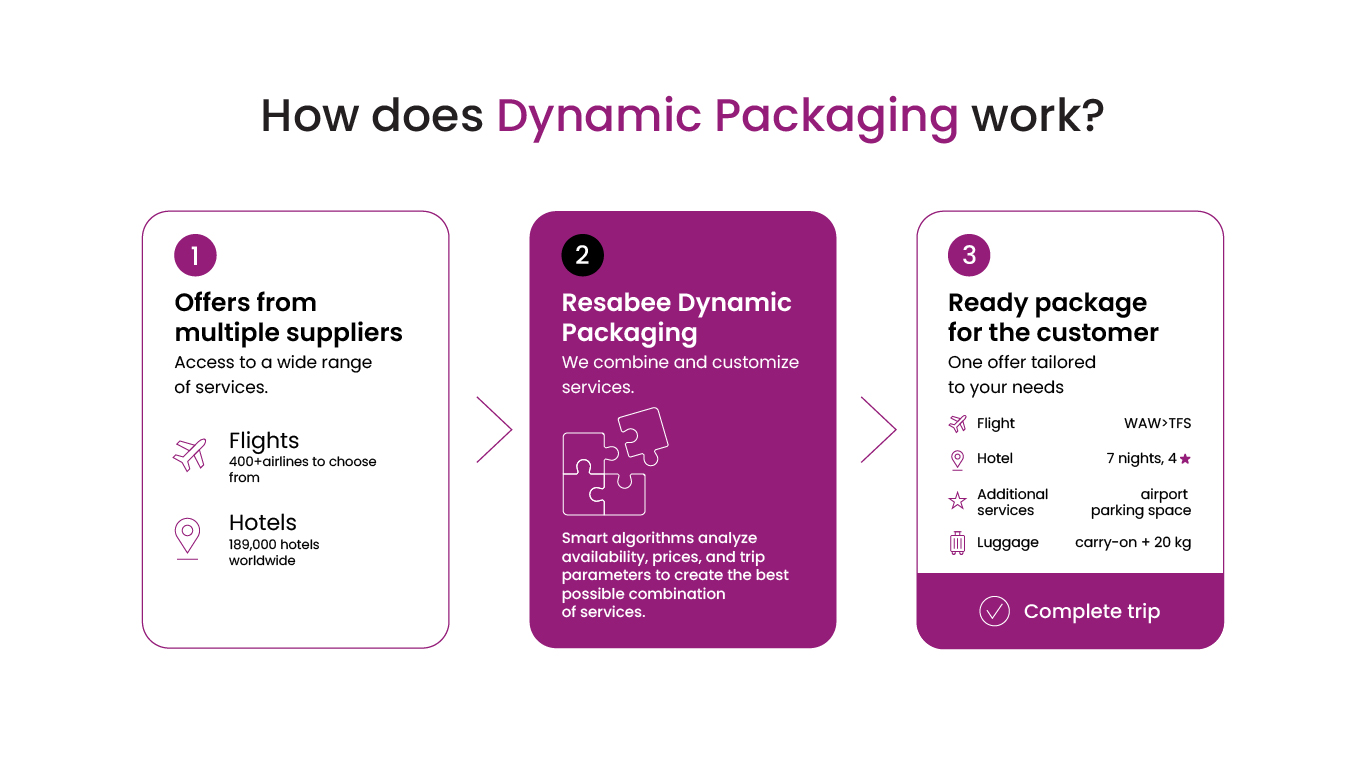
Dynamic Packaging combines different travel services into one package based on the needs of a specific customer.
Instead of searching separately for a flight, hotel, transfer or insurance, the agency can combine these services in one offer. The package is created from current availability and the customer's trip criteria, such as dates, departure airport, budget or hotel standard.
For the customer, this means one coherent offer covering the whole holiday. For the agency, it means less manual work when searching for and combining services, as well as faster offer preparation.
Resabee Dynamic Packaging supports this process by bringing flights, hotels and other services into packages built around customer requirements. Automation reduces the need to assemble each component manually, so the agent can focus on choosing the right option and closing the sale.
The size of a hotel database does not have to be the main source of a travel agency's advantage. The ability to combine different services into a trip that fits a specific customer can matter more.
A customer may start with a hotel search, but what they ultimately want to buy is a holiday. The flight and accommodation need to work together, while transfers, insurance and other services should fit the customer's budget and expectations.
Dynamic Packaging turns that need into a ready-to-sell offer. A travel agency does not have to win on hotel count. It can build its position around giving the customer the whole holiday rather than one isolated part of it.
See how Dynamic Packaging works and book a demo.