Customers Use AI to Plan Holidays. But Do They Trust It Enough to Book?

Travellers are increasingly using AI to find inspiration, compare destinations and choose holiday offers. When it comes to the final booking, however, they still need a greater sense of security. That is why the model with the greatest potential for travel agencies is one where AI handles the early stages of the process and a consultant steps in when the customer needs additional support or reassurance.
Are customers ready to plan holidays with AI?
AI is becoming a natural tool for travel research, but customers are not equally willing to use it at every stage of the purchase journey.
The ReiseZukunft / CENTOURIS study illustrates this difference clearly. 23% of respondents already use AI chatbots when planning travel. By comparison, 21% use social media and 19% use traditional travel agencies.
This marks an important shift in customer behaviour. AI is no longer an additional tool used by a small group of users. It is beginning to compete with channels that have influenced holiday choices for years.
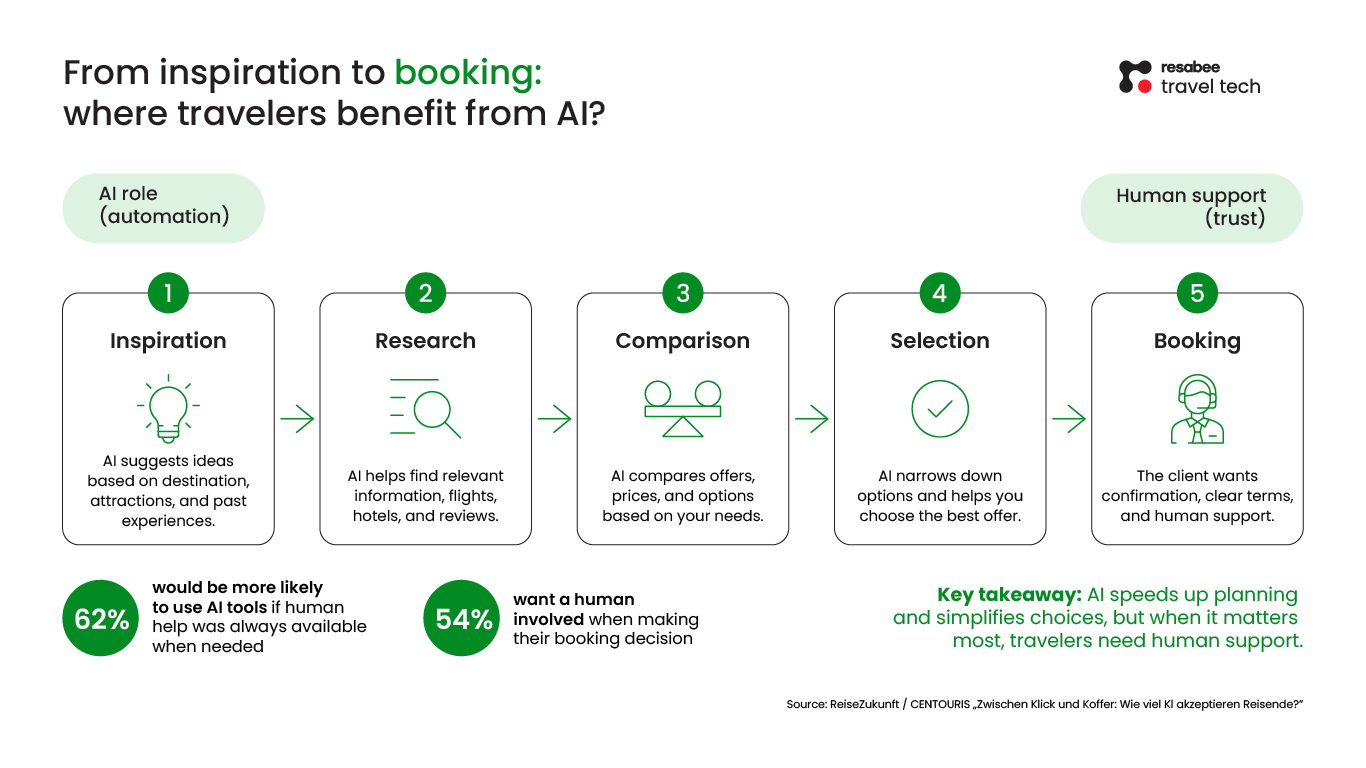
At the same time, the same study reveals a clear trust boundary. 62% of respondents say they would be more willing to use an AI agent if they could always turn to a human for help, while 54% want human involvement when approving a booking.
Customers are not rejecting AI. They want its speed and convenience, but for decisions involving greater responsibility, they still expect access to a human.
Where does AI work best in travel planning?
AI is particularly useful when a customer needs to narrow hundreds of possibilities down to a few offers that match their needs.
A traditional holiday search engine on a travel agency’s website requires travellers to set one filter after another: dates, departure airport, destination, hotel standard, board basis or budget. A conversation with AI can begin differently:
“I’m looking for a week by the sea in October, no more than a four-hour flight from Warsaw. We’re travelling with two children and want a hotel by the beach, but not a large resort.”
This allows the customer to describe their needs naturally, while the travel company can collect the information needed to prepare a more relevant proposal from the very beginning of the conversation.
AI can take over tasks such as:
- finding inspiration and choosing a destination,
- comparing destinations,
- narrowing down large numbers of hotels and offers,
- answering basic questions,
- identifying budget and preferences,
- preparing the customer for a conversation with a consultant.
This is no longer niche behaviour. The “Poles Travelling 2025” report shows that the use of AI when planning travel in Poland doubled within a year. Tools such as ChatGPT are used primarily to find inspiration, flights, hotels and attractions, as well as to create personalised travel plans.
Among people under 35, around 60% say they would be willing to use an AI assistant available directly within the booking process.
From AI recommendations to bookings
AI is not only helping customers choose a destination. It is increasingly directing them to websites where they can make a purchase.
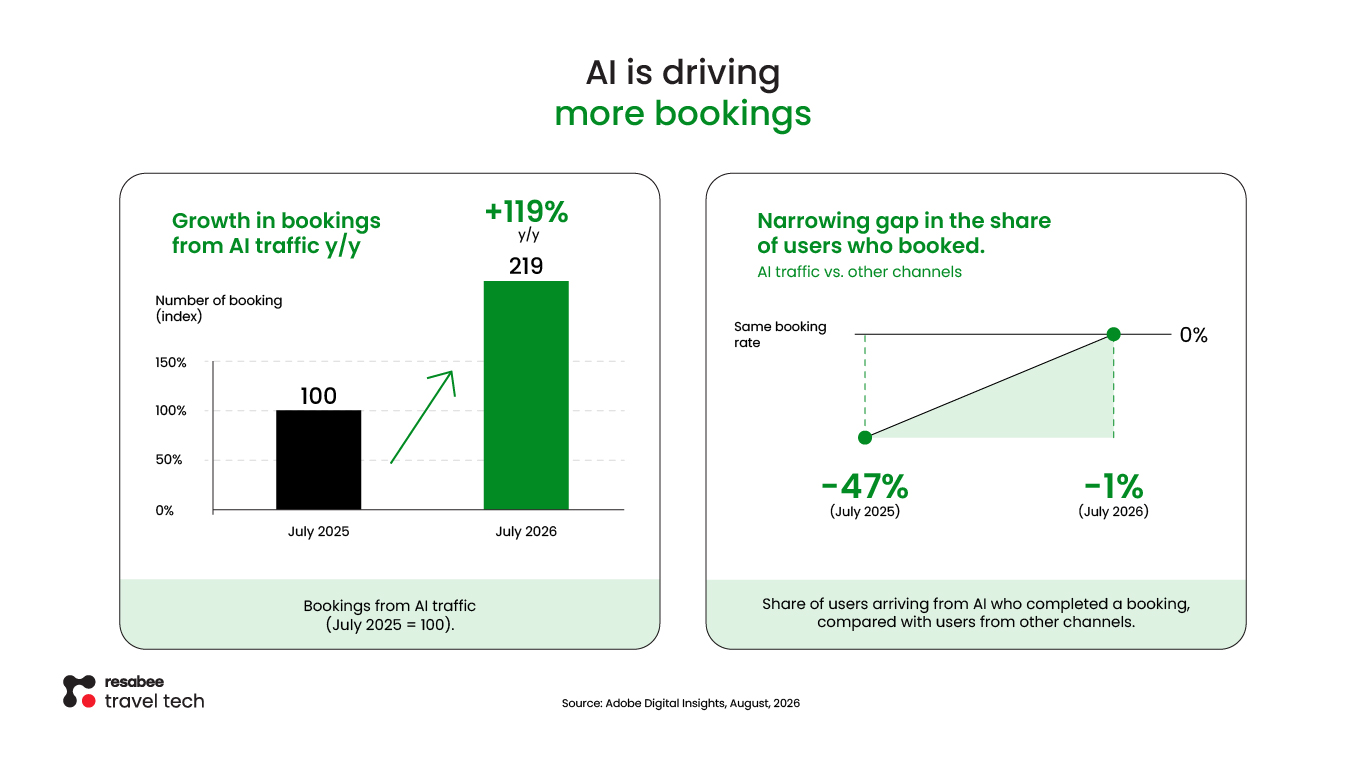
According to Adobe Digital Insights, traffic from AI tools to U.S. travel websites increased by 119% year over year in July 2026.
Research and inspiration are the most common uses of AI in travel, each cited by 43% of respondents. 41% use AI for transportation planning and 34% for itinerary creation. What is more, 84% of respondents said that using AI improved their travel-planning experience.
From a sales perspective, the quality of this traffic is even more interesting. In July 2026, conversion among users arriving from AI sources was only 1% lower than for traffic from other channels. A year earlier, the gap was 47%.
AI-referred users also showed a 21% higher engagement rate, spent 67% more time on travel websites and had a 42% lower bounce rate.
AI is therefore becoming more than a source of inspiration. Increasingly, it is bringing travel websites customers who are already much closer to making a purchase decision.
Booking a holiday requires more trust
A recommendation can easily be changed. A booking involves a real financial commitment, sharing personal data and accepting specific terms and conditions.
There is little risk in asking AI whether Crete or Tenerife would be a better destination in October. Entering passenger details, accepting booking conditions and paying several thousand euros is a different matter.
At this stage, questions about the consequences of the decision also arise. What happens if the flight changes? How do the cancellation terms work? Is baggage included? Does the hotel really meet the family’s needs? What happens if there is an error in a passenger’s details?
Travellers increasingly value the ability to organise an entire trip in one place. At the same time, when making a purchase, they still expect greater price transparency and a sense of security throughout the entire booking process.
The more complex and expensive the decision, the more important it becomes not only to receive a good recommendation, but also to know that a human is available when needed.
Do travellers still need contact with a consultant?
The CENTOURIS data is clear. 62% of respondents would be more willing to use an AI agent if human assistance were always available. 54% want human involvement when approving a booking.
That does not mean, however, that travellers want to start every interaction with a phone call or a visit to a travel agency.
They may start searching independently in the evening, compare several destinations, narrow down a list of hotels and answer questions about their needs. It is only when an unusual situation, an additional question or the final decision arises that they want the option to move to a consultant.
Human support is therefore not an alternative to AI. It can be one of the factors that makes customers more willing to use AI.
Is “AI or consultant?” really the right question?
For a travel agency, the more useful question is not “AI or consultant?”, but: which tasks should AI handle, and where does a human create the most value?
A consultant does not need to answer the same basic questions about weather, flight duration or hotel location every time. Nor do they need to begin every conversation by collecting the same information about dates, budget and number of travellers.
Their time is more valuable when the customer:
- has unusual requirements,
- wants confirmation before making a choice,
- needs the terms and conditions explained,
- wants to change part of a booking,
- is close to purchasing and needs additional reassurance,
- encounters a problem that requires human knowledge and experience.
The model with the greatest potential is therefore one where AI supports the consultant both before the customer conversation and throughout the later stages of service, taking over repetitive tasks and passing on issues that require experience and an individual approach.
The “AI First, Human When Needed” model
AI can take over repetitive tasks at the beginning of the purchase journey, while the consultant steps in when their knowledge, responsibility and experience create the greatest value.
A typical process might look like this:
- The customer starts a conversation at any time.
- AI identifies the dates, budget, traveller composition and expectations.
- It helps narrow down destinations and offers.
- The customer receives several relevant options instead of hundreds of results.
- AI answers basic questions.
- When an unusual requirement, need for confirmation or readiness to purchase appears, a consultant joins the process.
The point is not to remove people from travel sales. Consultants should enter the process where their involvement genuinely increases value for the customer and improves the chances of closing the sale.
How AI helps travel agencies handle more customer enquiries?
The main benefit is not automation itself. It is the ability to handle more enquiries without proportionally increasing the amount of repetitive work done by consultants.
Customer service does not end when the office closes
A customer may start planning a holiday at 10:30 p.m., on a Sunday or during a lunch break.
AI can begin the conversation immediately, collect their requirements and help narrow down the options. The company does not lose that first interaction simply because a consultant is unavailable at that moment.
Consultants do not have to start every conversation from scratch
If AI has already identified the budget, dates, departure airport, number of travellers and hotel preferences, the consultant receives a better-prepared customer.
Instead of starting with, “Where would you like to go?”, they can move directly to: “I can see you’re considering Rhodes and Crete. Let’s check which option would work better.”
Repetitive questions do not consume valuable selling time
Weather, flight duration, board basis, distance from the hotel to the beach or basic destination information are questions that come up repeatedly.
If AI handles some of them, consultants can spend more time with customers who genuinely need their experience.
Customers move from a need to a specific offer faster
Today’s traveller expects solutions that save time and simplify the organisation of a trip. At the same time, inspiration, planning and booking are increasingly becoming one connected process.
A well-designed AI assistant should therefore not become another layer of technology. It should shorten the path between the customer’s first question and the right offer.
How does Zoya combine AI technology with human consultant support?
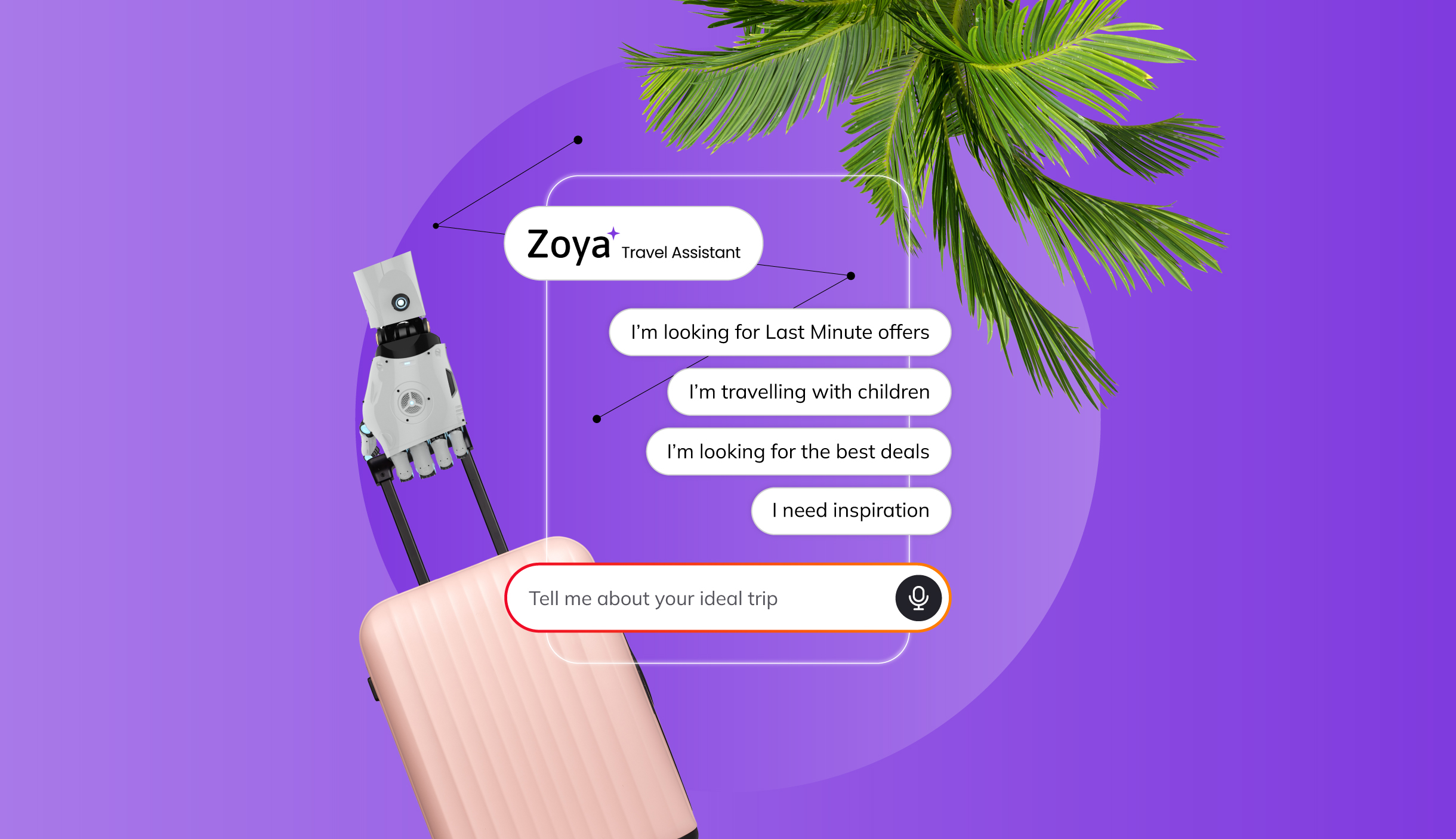
Zoya is an AI travel assistant that supports travellers at every stage of their journey — before booking, during the purchase process and after the reservation is made. It can start a conversation, identify the traveller’s needs and guide them towards the right offer, while keeping the human consultant involved in the process.
Instead of starting with a long form or a set of filters, the customer can describe their expectations in natural language. Zoya helps collect the necessary information, narrow down the options and guide the customer further through the process.
If an issue requires human expertise or the customer wants additional reassurance before making a decision, the consultant remains part of the journey.
The AI First, Human When Needed model automates the moments when customers primarily expect speed and convenience, while preserving human involvement where experience builds trust and helps close the sale.
Who will win the AI era in travel?
The winner does not have to be the company that automates the most. A stronger advantage may belong to the company that best combines the speed of AI with the trust that comes from human support.
AI is already beginning to generate valuable purchase traffic and is becoming part of everyday travel planning at a rapid pace. At the same time, it is also revealing the limits of automation: even customers who are open to new technologies still want to know that they can turn to a human at the right moment.
In the coming years, the most important question will not be whether AI will replace consultants, but how technology can support their work and provide customers with faster, more personal and more reassuring service when choosing a holiday.
Discover how Zoya AI Assistant can support travellers from their very first question, through choosing the right holiday offer, and even after booking — book a 30-minute conversation.