The AI Act from 2 August: Which AI Content Must Travel Agencies Label?


From 2 August 2026, the full transparency requirements of the AI Act (Article 50) will come into force across the European Union. If your travel agency generates tour descriptions using ChatGPT, retouches hotel photos using Midjourney, or creates videos with an AI voice-over for TikTok – you need to know when you have a legal obligation to inform the customer of this, and when you can publish content without any labelling.
However, rather than treating the new regulations as an obstacle, view them as an opportunity to build a competitive advantage. In an industry where transparency determines which offer customers choose, the wise implementation of the AI Act builds what is most valuable in tourism: customer trust.
What is the AI Act, and why is 2 August 2026 a key date for travel agencies?
The AI Act, formally Regulation (EU) 2024/1689, is an EU legal framework introducing consistent standards for the safe and transparent use of artificial intelligence across the European market. In tourism, where customers often make purchasing decisions based on attractive photographs, videos and descriptions, the regulation is intended to protect travellers from being misled about the actual standard of an offer.
2 August 2026 is a key date because this is when the transparency provisions under Article 50 of the AI Act become fully applicable. From that date, travel agencies, which will usually act as deployers of AI systems, will be required to comply with specific content-labelling rules.
Failure to comply with transparency obligations relating to synthetic content may result in administrative fines of up to EUR 15,000,000 or up to 3% of the company’s total worldwide annual turnover, whichever is higher. Penalties are adjusted to the scale of the business.
Who is responsible for what: the tool provider vs your travel agency
Under the AI Act, a travel agency, tour operator or online travel agency generally acts as a deployer – a natural or legal person using an AI system as part of their professional or commercial activities. Software developers and platform operators, such as OpenAI or Midjourney, act as providers.
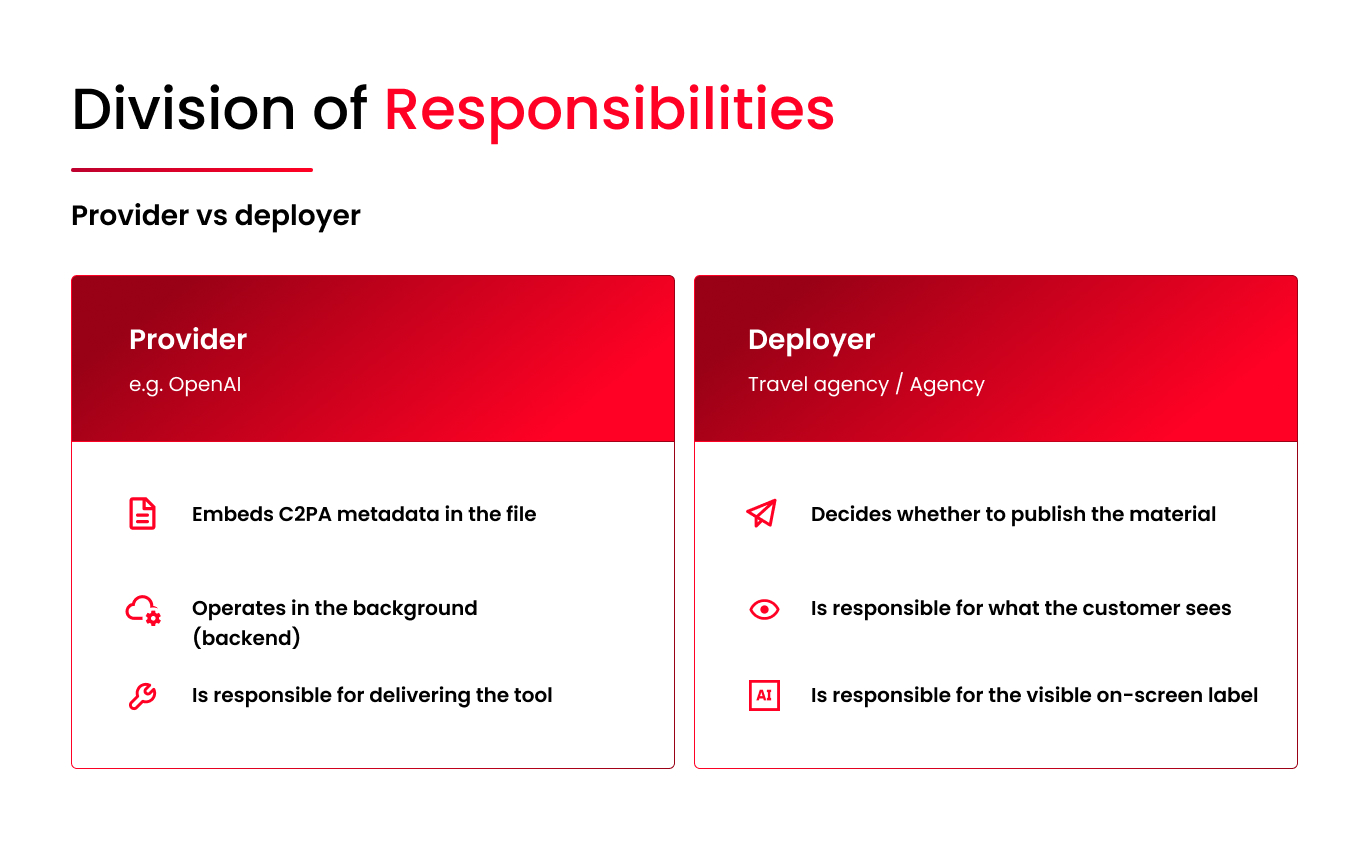
The conclusion is clear: it is the travel agency that publishes the material through its own channels and is therefore responsible for ensuring that customers can see a clear and readable label. Invisible watermarks or background metadata added by the software provider do not remove this obligation.
AI-generated video and audio: when does a hotel promotion become a deepfake?
The greatest risk lies in the most engaging formats: videos, reels and short-form content.
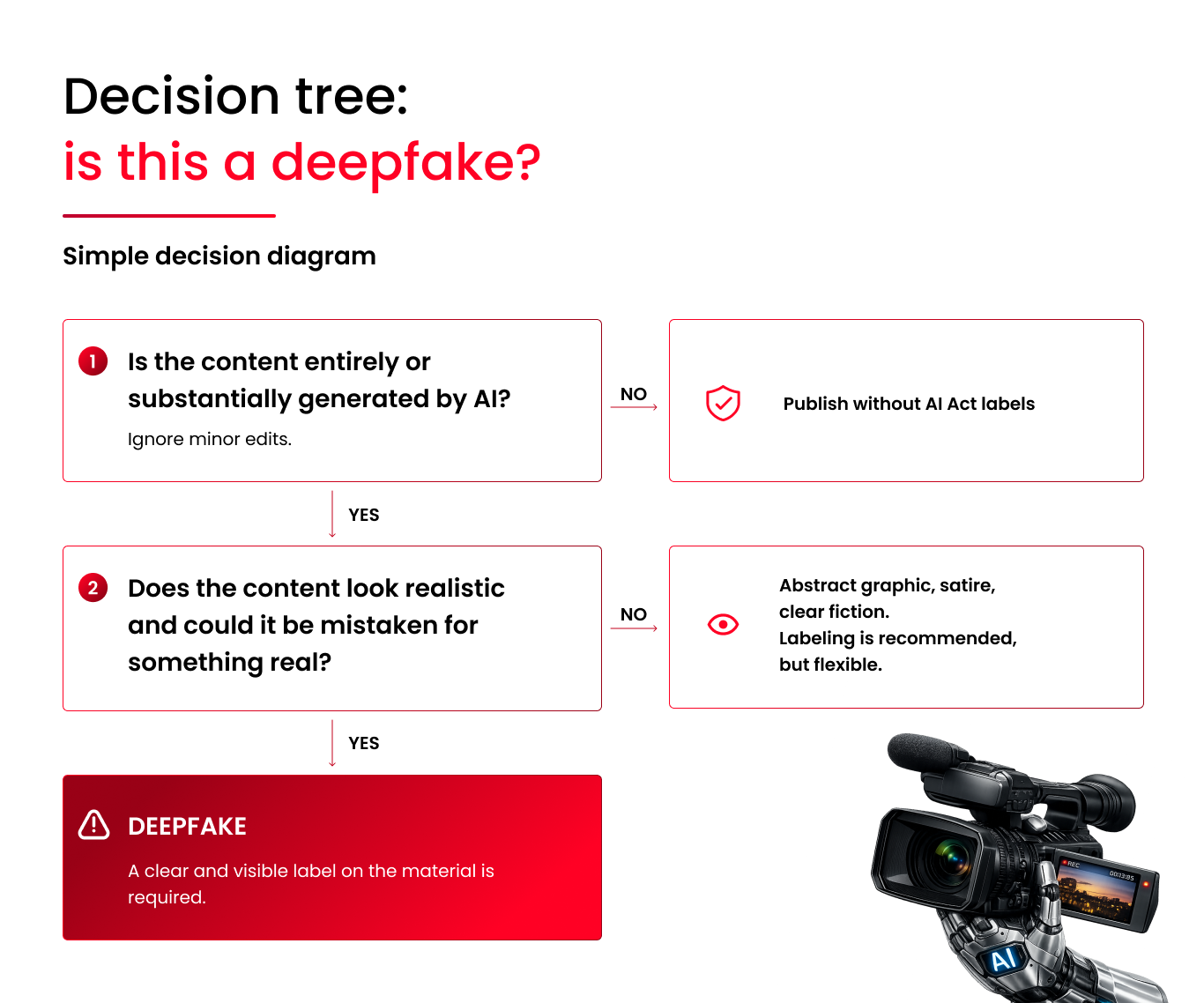
A visible label is required when video or audio content constitutes a deepfake within the meaning of Article 50(4) of the AI Act. This means content that resembles real people, places, objects or events and could be mistakenly perceived by the audience as authentic.
In the tourism industry, this definition is particularly important. A deepfake does not have to depict a person – it can also concern hotel facilities, buildings, landscapes or destinations.
What must be labelled from 2 August 2026?
You must label:
- a realistic AI-generated video depicting a specific hotel or travel destination;
- significant alterations to authentic photographs, such as digitally replacing the actual view from a window with a more attractive one, removing a neighbouring building and adding a forest, inserting a non-existent swimming pool or changing the appearance of hotel rooms;
- a synthetic voice-over using a cloned or AI-generated version of a real person’s voice in promotional travel content;
- a digital avatar presenting the terms of an offer in a video;
- content depicting an event that never occurred in a way that suggests it genuinely took place.
A useful rule of thumb is this: if a customer viewing an image or video could believe they are seeing genuine footage from a particular location, the material should carry a visible label.
Minor editing and the AI Act: which changes do not require a label?
Not every use of AI needs to be disclosed. As a general rule, the labelling requirement does not apply to:
- clearly recognisable animations;
- content with an obviously illustrative, fantastical or stylised character;
- standard special effects and technical post-production;
- content that an average viewer would not reasonably consider authentic.
Context is crucial. Whether a label is required does not depend solely on the format, such as whether something is an animation or special effect. The key question is whether the material could mistakenly be perceived as genuine.
To determine this, consider:
- the level of realism and resemblance to reality;
- the message conveyed by the content;
- where and how the material is published;
- the expectations of the intended audience.
Although standard effects and technical editing will usually not mislead viewers, the exemption from labelling is never unconditional. Each case must be assessed individually.
How should AI-generated video and audio be labelled?
The label must reach the customer at first exposure to the content and must be clear, noticeable and easy to understand. Adding a disclosure only at the end of a social media caption is not enough, as the video may be downloaded, shared or embedded without the accompanying text.
A safer approach is:
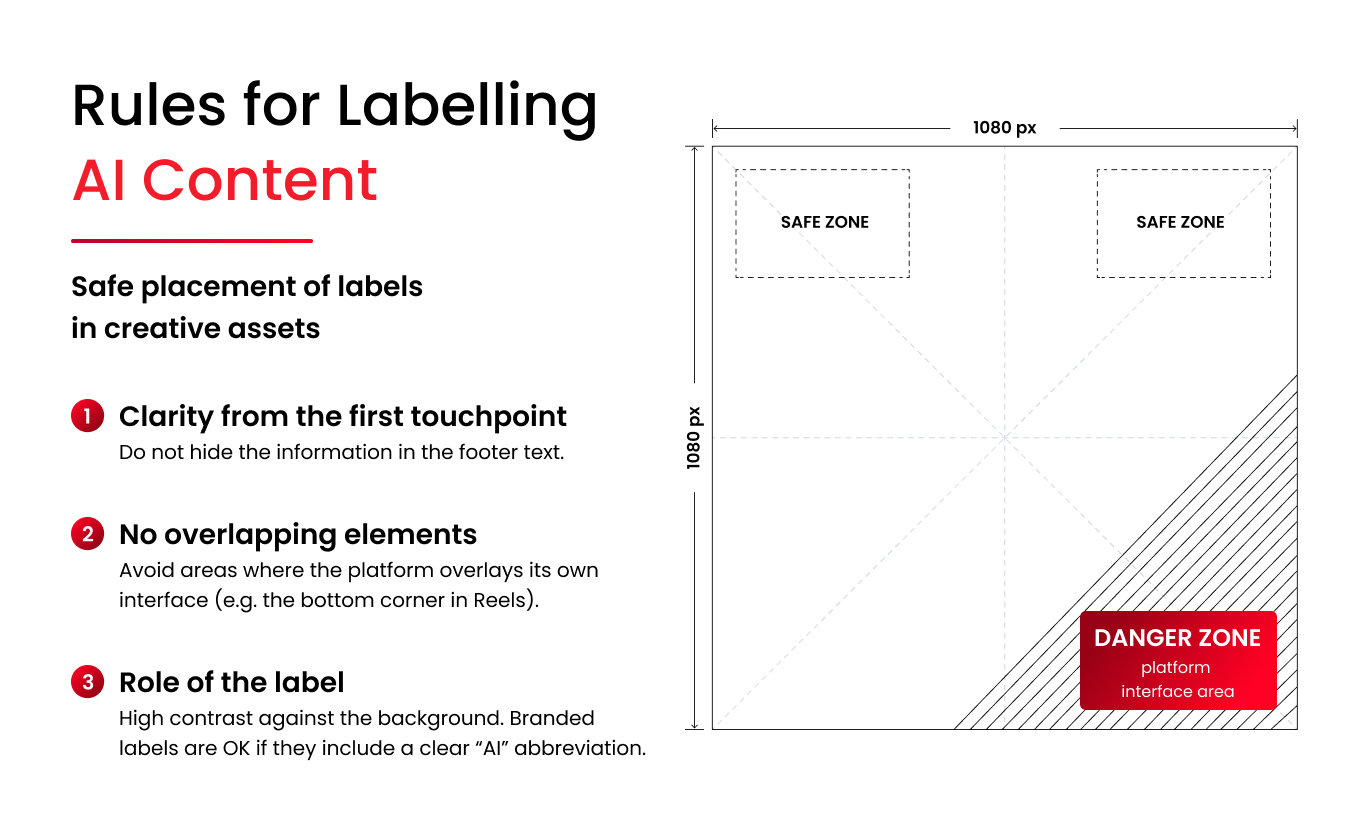
- for video: add a clear, high-contrast label or icon directly to the video file. Remember to keep it within the safe zone so it is not covered by app buttons or interface elements;
- for audio: include a short spoken disclosure at the beginning of the recording, for example: “The voice in this recording was generated using AI”.
Graphics and hotel photographs: where is the line between editing and altering the offer?
The same rules apply to graphics and photographs as to video. If an alteration could influence a traveller’s purchasing decision – for example, by making a room appear larger or removing a construction site next to the hotel – the image may qualify as a deepfake.
It is also important to remember that presenting modified hotel infrastructure as authentic is not only a potential breach of the AI Act. It can also lead directly to customer complaints concerning a discrepancy between the advertised offer and the actual service, as well as a wave of negative online reviews.
AI in copywriting: do tour descriptions and ChatGPT-generated posts need to be labelled?
The good news is that the vast majority of marketing copy does NOT require labelling.
Standard marketing materials such as:
- descriptions of hotels, tours and sample itineraries;
- posts promoting travel offers;
- social media posts, promotional emails and newsletters;
- advertising slogans, landing page copy and advertising scripts
do not require a visible label solely because they were created with the assistance of AI.
When must AI-Generated text be labelled?
The obligation arises only when all four of the following conditions are met:
- the text is intended to inform the public; AND
- it concerns a matter of public interest – in tourism, this may include official visa information, government travel warnings or emergency announcements concerning natural disasters; AND
- it was generated by AI; AND
- it has not undergone substantive human review and editorial control.
The solution: A human-in-the-loop process
Introduce a simple internal procedure under which every informational text created with AI assistance is fact-checked by an employee, such as a product manager or copywriter, and formally approved before publication.
A purely linguistic or stylistic edit is not sufficient. The review must cover the factual accuracy and substance of the content.
The advertising platform trap: Meta and Google Ads
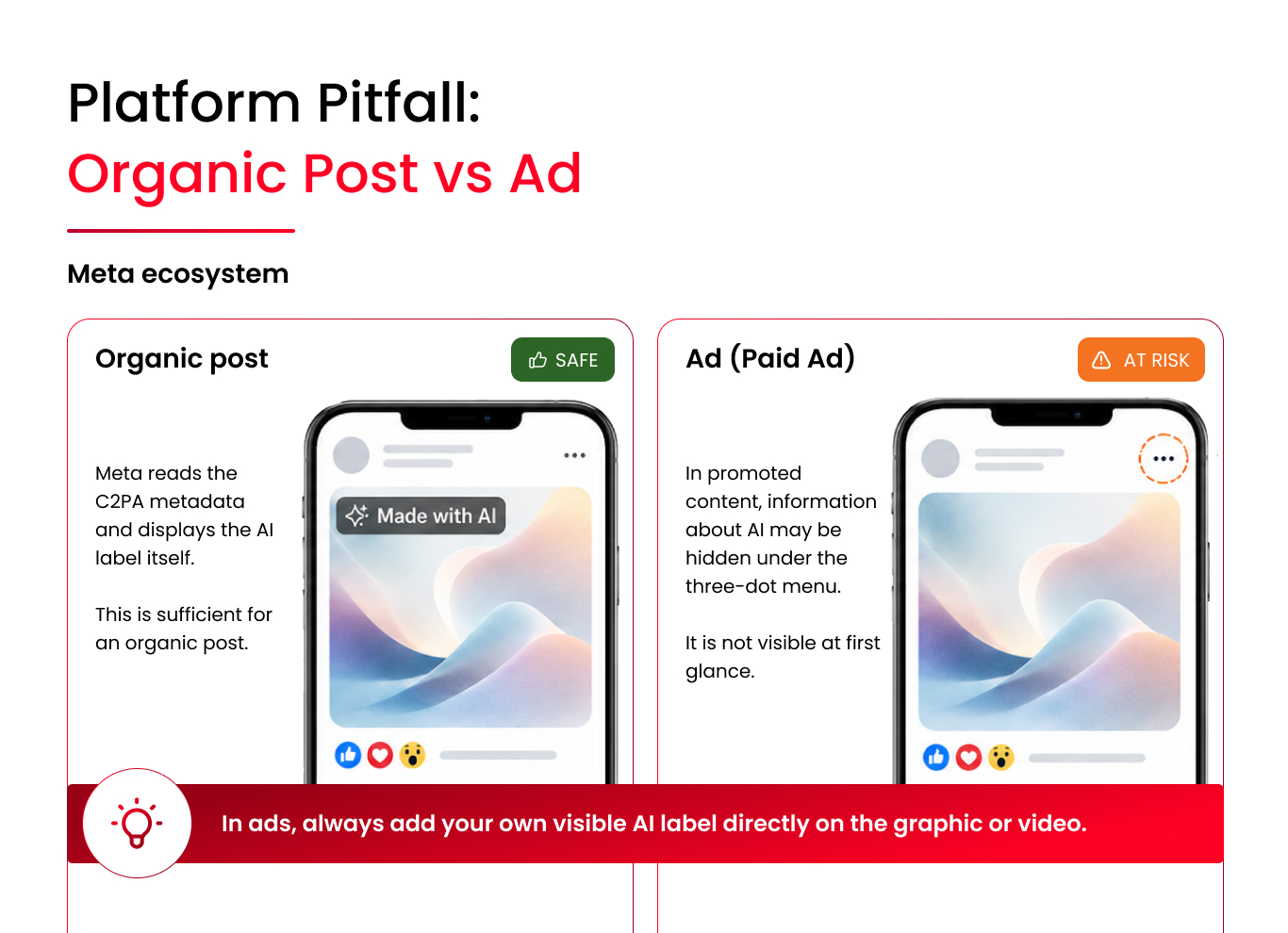
Instagram and Facebook may automatically detect metadata and add a “Made with AI” label to an organic post.
However, when the same post is converted into a paid advertisement, advertising platforms may hide the label behind a three-dot menu. According to EU guidance, information concealed inside an expandable menu does not satisfy the requirement for disclosure at first exposure.
The solution: when creating paid advertisements that use deepfake or AI-generated content, always add a permanent label directly to the image or video before uploading it to the advertising platform.
Chatbots and virtual advisers on travel agency websites: the first-contact rule
When implementing an AI-powered virtual assistant, whether on your website or through a messaging platform, you must clearly inform the user that they are interacting with a machine rather than a human.
This information must be provided no later than at the beginning of the interaction. In practice, a simple greeting in the chat window is sufficient, for example: “Hello! I’m the travel agency’s AI virtual adviser, and I’ll help you find the right holiday”.
How should AI Content be labelled? EU standards and official icons
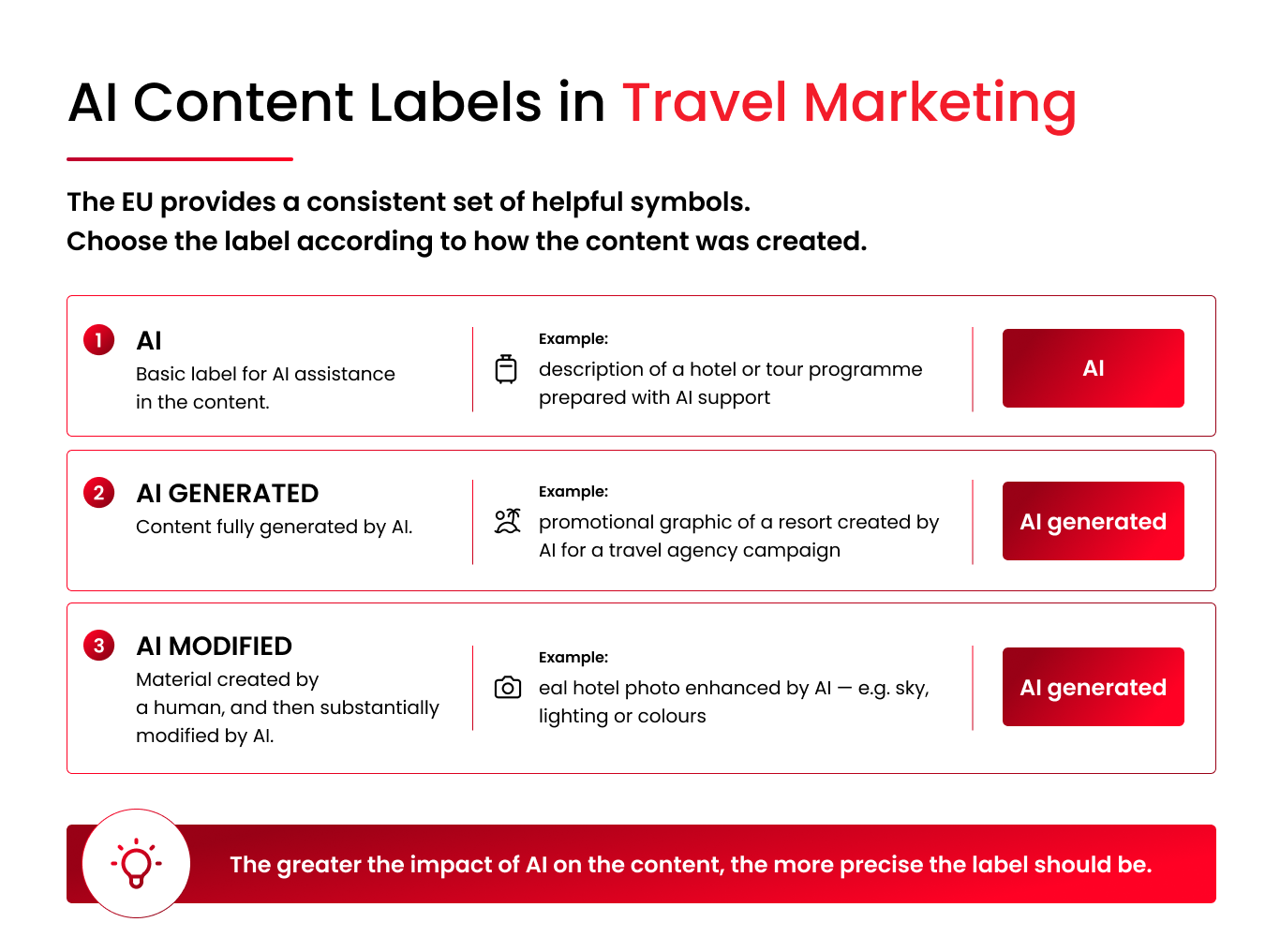
Introducing labels does not have to compromise the visual quality of your content. The European Union provides a consistent set of supporting symbols:
- General AI Icon: used as a basic indication that artificial intelligence was involved in creating the content;
- AI Generated Icon: used when the content was created entirely by an AI system and the only human input was the prompt;
- AI Modified Icon: used when content originally created by a human has been significantly manipulated or expanded using AI.
A formula for a safe and visually appealing label
- Supplement the icon with an unambiguous message, such as “Image generated by AI” or “Image partially modified using AI”;
- Place the label in the upper corner of the material, away from interface elements, action buttons and the author’s profile information;
- Make sure the label contrasts clearly with the background and remains legible on smartphone screens.
Four steps to prepare your travel agency for digital change
Adapting your travel agency’s marketing processes to the requirements of the AI Act does not mean abandoning artificial intelligence. The key is to introduce an organised review process and communicate transparently with customers.
To prepare your business, you should:
- audit your marketing activities to identify where synthetic content is created, including graphics, video, audio and chatbots;
- develop standard AI labels for each content format;
- implement human review procedures for communications concerning matters of public interest;
- train your team and provide marketers with clear guidance on how to distinguish a deepfake from minor editing.
What about existing content? The rules for materials published before 2 August
The entry into force of the new provisions naturally raises questions about archived content. However, the position is clear: there is no obligation to retrospectively label deepfakes that were generated and published before 2 August 2026.
The law does not apply retroactively in this respect.
Are you unsure whether your e-commerce systems and marketing processes are ready for digital change?
EU regulations are no reason to slow down your digital marketing efforts. Quite the opposite – this is the perfect time to organise your company’s digital processes and invest in secure automation.
At Resabee Travel Tech, we understand that technology should, above all, drive sales and save you time. With dedicated Resabee Marketing for Travel services, we help travel agencies benefit from AI innovation and sales automation while remaining fully confident that their activities are safe and legally compliant.
Would you like to find out how to prepare your travel agency’s marketing for the new standards without unnecessary stress? Let’s talk about your business challenges.
.png)